An MS in Health Tech Class of 2023 alumni, Ben Hardin, is featured in this highlight of The Shop in the Siebel Center for Design!
This year’s recipient of the Michael Vitoux Health Technology Scholarship is Dr. Laelaf Hailu. Throughout Hailu’s academic career at University of Illinois Urbana-Champaign, he has displayed intuitive thinking and great interest in the field of health technology.
“There are not many programs designed to allow students from various backgrounds to come together and learn,” Hailu said. “The MS in Health Technology program at UIUC is unique in that the College of Applied Health Sciences works in collaboration with the Grainger College of Engineering to provide a unique opportunity to pursue my goals.”
Hailu chose this particular program because he has always been passionate about technology and the power it has to change people’s lives. After receiving his medical degree from the University of Gondar in Ethiopia, he knew he wanted to develop his technical skills and enter a master’s program that would lay the foundation for a career in digital health.
“The scholarship means so many things to me. As an international student, funding is one of the main criteria when trying to select programs to apply for.” Hailu shared his gratefulness to the department for awarding him this scholarship.
After graduation, Hailu plans “to work in helping patients utilize the power of technology.” The implications for technology’s use in medicine and healthcare are an emerging field with endless possibilities, Hailu wants, “to do my part and contribute to improving people’s lives.”
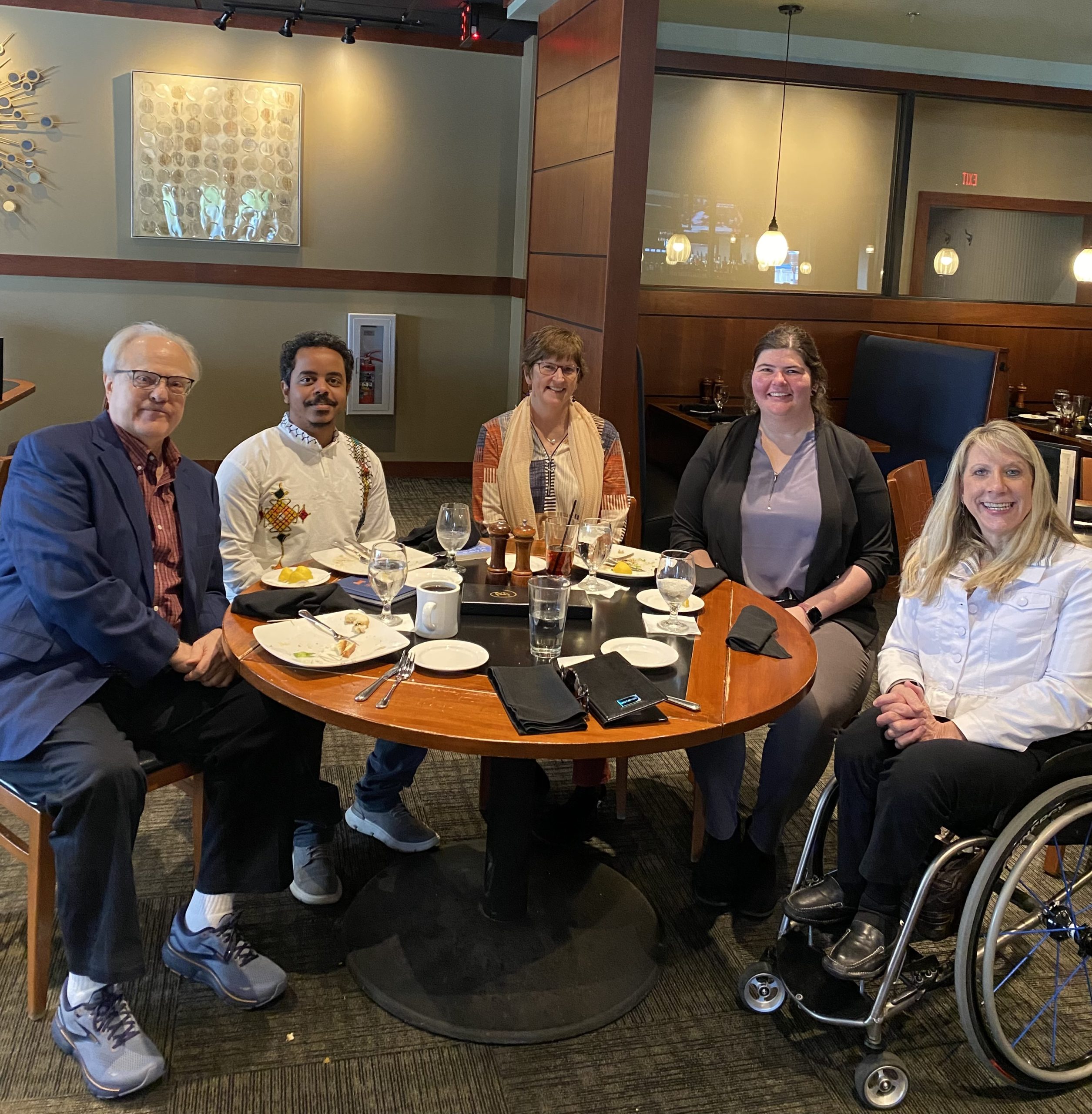
In April 2024, Lalef Hailu was able to meet with Michael Vitoux, scholarship donor, Wendy Rogers, Health Technology Education Program Director, Katelyn Talbott, Health Technology Education Program Assistant Director, and Jean Driscoll, Assistant Dean for Advancement for a celebratory lunch. During the lunch, all had the exciting opportunity to view the near totality of the solar eclipse!
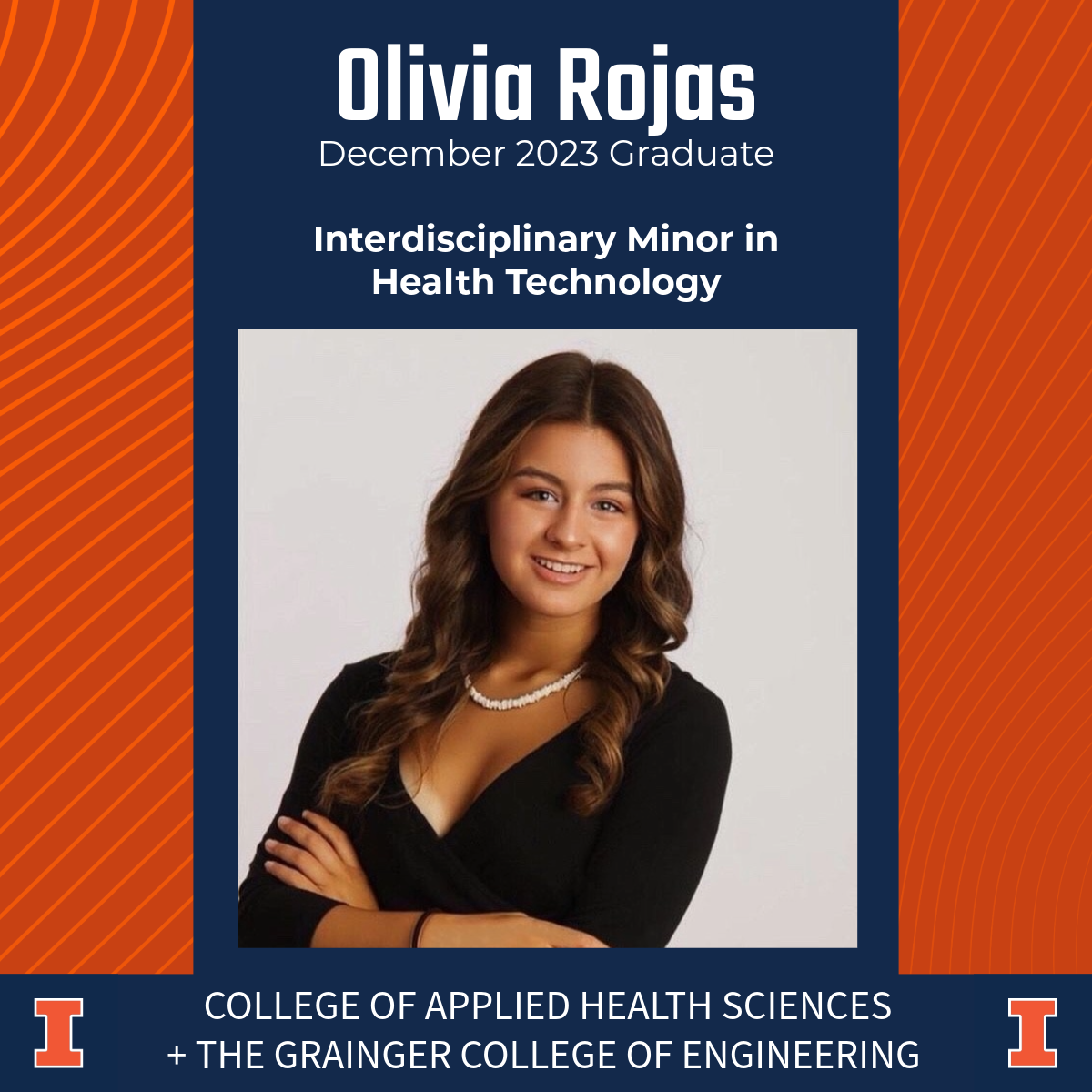
Olivia Rojas, a native of Barrington, IL, graduated in December 2023 from the College of Applied Health Sciences with a degree in Community Health and a concentration in Health Planning & Administration. To complement her degree, Olivia also graduated with an Interdisciplinary Minor in Health Technology. Rojas is the first graduate to have earned the Interdisciplinary Minor in Health Technology. This minor is through the Health Technology Education Program (HTEP) in the College of Applied Health Sciences and in collaboration with the Grainger College of Engineering. When asked why she decided to pursue the minor, Rojas noted “the constant change for technology in the healthcare world!” She continued that “technology is an aspect of life that is constantly changing, but to grow with the technology and not fall behind, it is crucial to further your education in any way possible. Technology can have the opportunity to save one’s life and make living easier for those who are sick. It was vital that I took this minor to learn as much I could about the healthcare world to support my major.” Dr. Katelyn Talbott, HTEP assistant director, is excited for the first of many graduates in the upcoming years. “I am thrilled for Olivia to be our first graduate obtaining our Interdisciplinary Minor in Health Technology! From our meetings, Olivia has found great value in the minor that will prove to be a great complement to her career goal of healthcare administration. This minor is beginning to take off as students see how relevant it is to all majors on campus.” With the 19-credit hour minor being interdisciplinary, Rojas notes how the minor helped her achieve a better understanding of technology usage in the healthcare industry. “We took a closer look at how different forms of technologies are created, but also how they can be beneficial to patients and various types of facilities.” Rojas noted that this minor required courses outside of her traditional plan of study, but that “it was a great way to dip my feed into the IT world while incorporating my healthcare background.” This fall, Rojas will be pursuing her Masters in Healthcare Administration in the College of Applied Health Sciences here at the University of Illinois Urbana Champaign. As she waits for the fall start, Rojas is enjoying her time at home and working at Illinois Bone and Joint, coaching volleyball, and spending time with family. The Interdisciplinary Minor in Heath Technology is part of the Health Technology Education Program through the College of Applied Health Sciences and in collaboration with Grainger College of Engineering. In addition to the Interdisciplinary Minor in Health Technology, HTEP also offers an undergraduate Health Technology certificate; a one-year MS in Health Technology degree; opportunities for Capstone Project Partners from industry, government, and academia; professional education modules; and CHLH 203 – Introduction Health Technology – a Social Sci general education course.
Health Technology is excited to announce our Spring Speaker Series presenter, Dr. Chris Wickens. Wickens earned a B.A. from Harvard College in Physical Sciences in 1967. He received an M.A. from the University of Michigan in Psychology in 1969. He completed his Ph.D. under Dick Pew at Ann Arbor in 1974. Wickens advanced from Assistant Professor to Professor in the Department of Psychology at the University of Illinois at Urbana-Champaign. He was Visiting Professor, Department of Behavioral Sciences & Leadership, U. S. Air Force Academy in 1983-1984, 1991-1992, and 1999-2000. His research on human factors has been internationally recognized.
Health Technology Spring Speaker Series: Dr. Chris Wickens
Tuesday, April 16 @ 4:00pm
Beckman Tower Room 2269 or Zoom
Title: An Influence Model of Human-Automation Team Interaction
Abstract: I present a model of the influence of three features of automation, its reliability, its level of transparency and its degree of authority, on two major measures of performance of the human-automation team: Performance of the routine task for which the automation was designed, and performance of the team when automation unexpectedly fails. The computed influences are mediated by human cognitive variables of trust, dependence, situation awareness and workload. The “weights” of these influences are derived from meta-analyses of human-automation interaction studies, and can be used to predict tradeoffs in design. Three such tradeoffs are presented.
A reception will follow the presentation in Beckman Tower Room 2269.